
A Technical Guide with Thermal Imagery — Palazzo Construction
Palazzo Construction Ltd. • Vancouver & Lower Mainland • September 2025
Homes built before modern codes often leak conditioned air through attics, rim joists, and service penetrations. This guide shows how we diagnose and sequence fixes using blower‑door testing, infrared scans, and targeted air‑sealing and insulation upgrades. It follows practices referenced by provincial guidance and federal resources for audits and retrofits (Province of British Columbia, 2025; Natural Resources Canada, 2024).
Step‑by‑Step Diagnostic
- Interview & Utility Review — Collect heating bills and occupant comfort issues; note drafty rooms, condensation, or ice‑damming.
- Exterior Survey — Look for gaps at siding/trim, deteriorated seals, vent terminations, and attic ventilation.
- Blower‑Door at 50 Pa + IR Scan — Depressurize the house and walk with a thermal camera to visualize leakage paths and missing insulation.
- Attic & Crawlspace Check — Verify insulation depth, air/vapour continuity, and penetrations around lights, hatches, plumbing, and chimneys.
- Report & Scope — Prioritize low‑cost/high‑impact air‑sealing, then insulation, then equipment upgrades.
Common Leakage & Thermal Defects (Where to Look)
- Attic hatches and pull‑down stairs (often unsealed).
- Recessed lights and bath fans (bypass the air barrier).
- Rim joists and sill plates at the foundation.
- Chases for plumbing/vent stacks; around chimneys (fire‑safe air‑sealing required).
- Window/door weather‑stripping and thresholds.
- Cantilevered floors and knee walls behind tubs or showers.
Thermal Imagery & Diagrams (Illustrative)
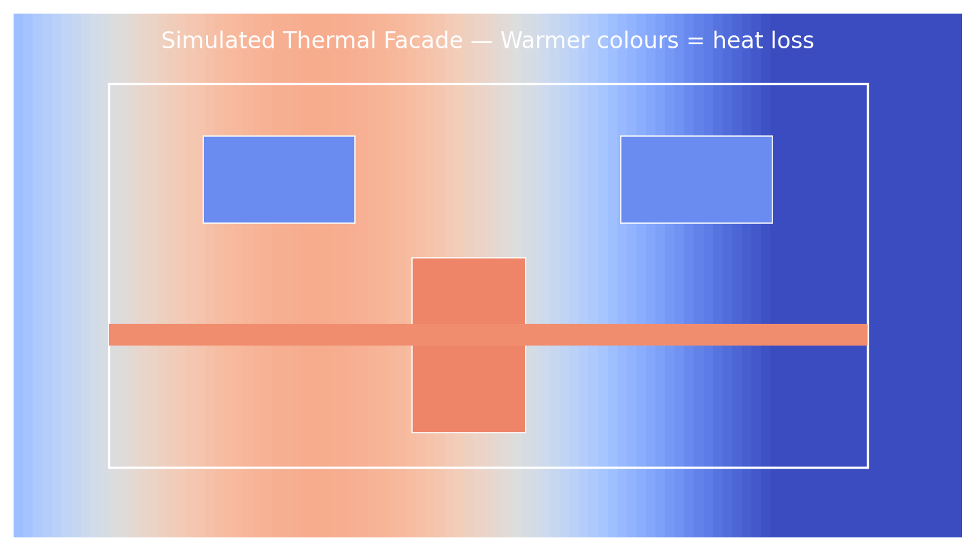
Simulated thermal view of a façade — warm band at rim joist and leaky door.
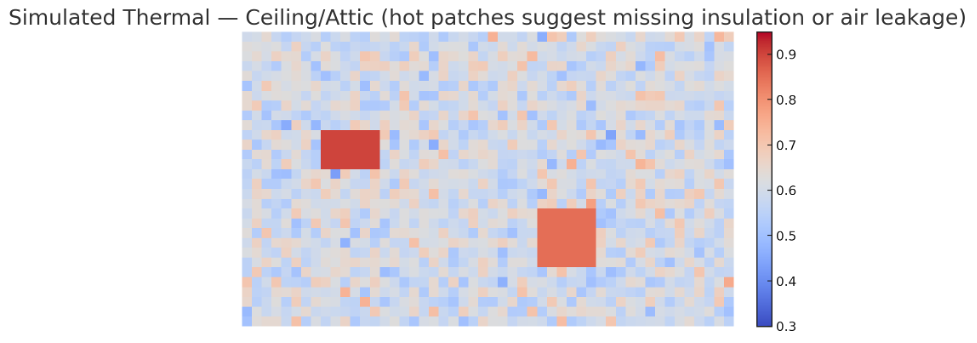
Thermal map of ceiling/attic — hot patches suggest missing insulation or bypasses.
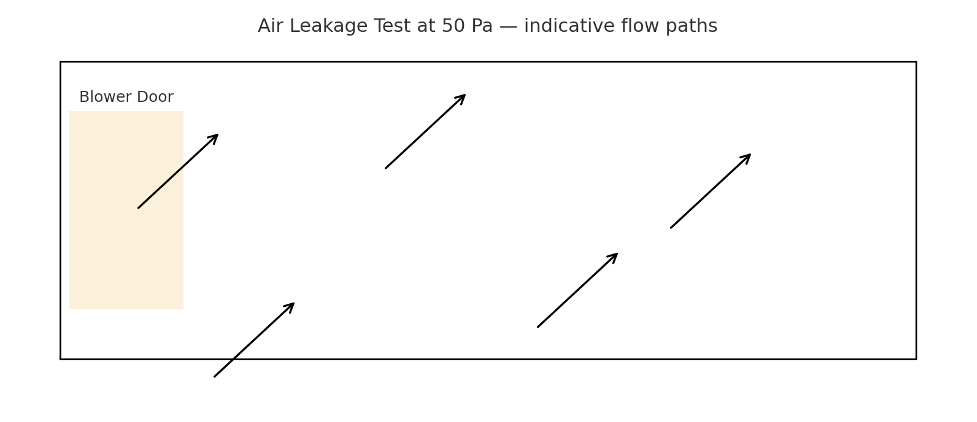
Blower‑door airflow paths at 50 Pa — trace leaks to the exterior.

Palazzo energy‑audit workflow from interview to scope.
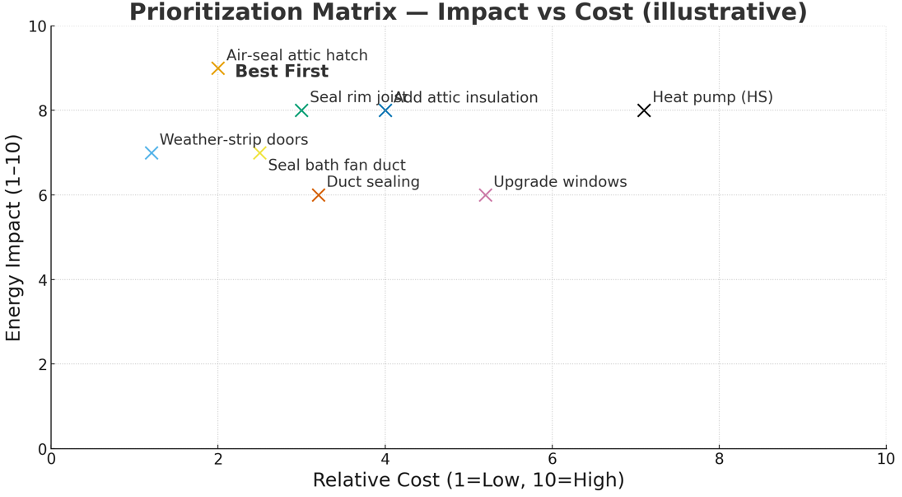
Prioritization matrix — tackle high‑impact, low‑cost air‑sealing first.
Air‑Sealing & Insulation Playbook (Older Homes)
- Attic: seal penetrations (lights, stacks, top plates) with fire‑rated foam/caulk where appropriate; weather‑strip and insulate the hatch.
- Rim joist: cut‑and‑cobble rigid foam sealed with spray foam, or continuous exterior insulation during recladding.
- Bath fans: replace with ENERGY STAR, seal to the air barrier, and vent directly outdoors with smooth ductwork.
- Insulation targets: aim for effective R‑values consistent with current code guidance; confirm vapour control for assemblies in a coastal climate.
- Windows/doors: verify air‑tight installation (shims, tapes, backer rod, sealant) before considering replacement.
Quick Checklists
Attic: [ ] hatch sealed [ ] top plates sealed [ ] recessed lights covered [ ] baffles at eaves [ ] insulation depth verified
Basement/Crawl: [ ] rim joists sealed [ ] sill plate gasketed [ ] duct leakage tested [ ] penetrations sealed
Living areas: [ ] weather‑strip doors [ ] adjust door sweeps [ ] seal window trim [ ] close fireplace dampers
References (APA 7th)
Province of British Columbia. (2025). Home energy efficiency and retrofit guidance. https://www2.gov.bc.ca/
Natural Resources Canada. (2024). EnerGuide home evaluations and airtightness testing. https://natural-resources.canada.ca/
City of Vancouver. (2025). Insulation, ventilation and energy efficiency resources. https://vancouver.ca/
Copyright & Editorial Integrity
Original writing and visuals created for Palazzo Construction. Facts are paraphrased from official sources cited above; no verbatim copying. © Palazzo Construction Ltd. All rights reserved.
Palazzo Construction Ltd. • Vancouver & Lower Mainland • September 2025
Appendix — Updated High‑Legibility Figures
The following figures replace their earlier versions for improved readability in print and on web.
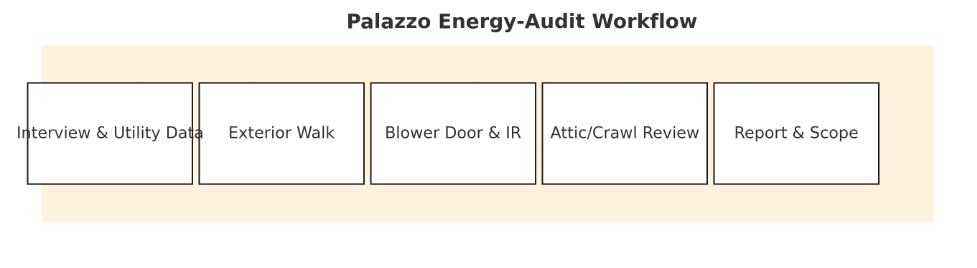
Updated: Palazzo Energy‑Audit Workflow (high‑DPI, larger fonts).
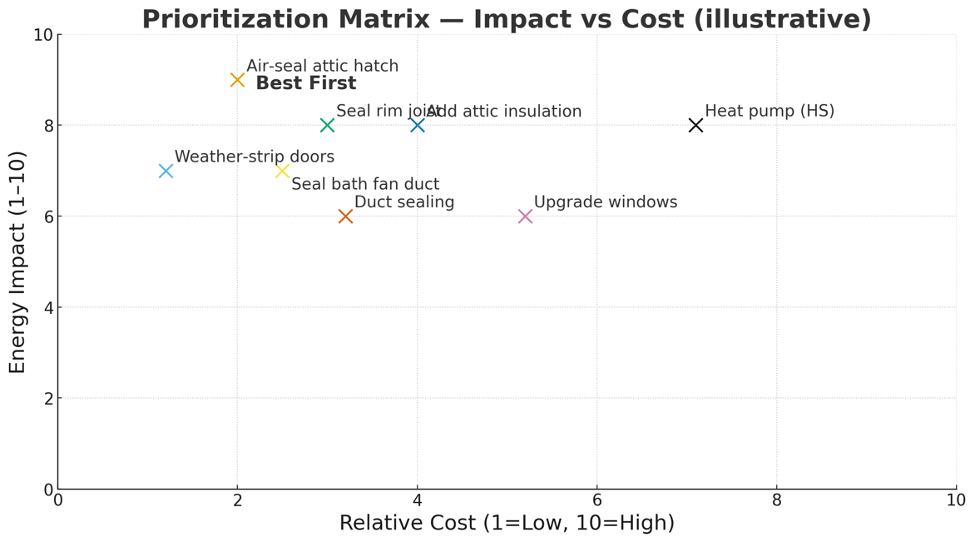
Updated: Prioritization Matrix — Impact vs Cost (high‑DPI, larger fonts).